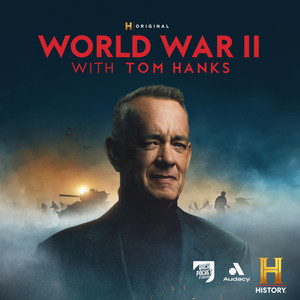
What this podcast really covers
The series is built around a central analytical premise: the Second World War is not yet history in the sense of being resolved and inert. Its outcomes — the UN security architecture, the nuclear deterrence balance, the division of Europe, the emergence of American global hegemony — remain the operating system of contemporary international relations. The podcast's ambition is to make that continuity legible to listeners who may know the major battles but not the structural forces driving them.
Each episode chooses a distinct lens. Blitz examines what sustained civilian morale under systematic aerial bombardment — a question with direct resonance for any society facing asymmetric violence. Barbarossa traces how Hitler's decision to open a two-front war violated the core strategic logic that had made German expansion viable, and how Soviet industrial resilience — not just military valor — ultimately turned that mistake fatal. Operation Torch introduces the political complexity of the North African campaign, where Allied coordination across three nations required diplomatic management as demanding as battlefield command. Darkness Falls examines the full scale of the Holocaust, treating it not as a sidebar to military history but as an integral dimension of what the war actually was.
The episode on Secrets and Lies is particularly significant: it treats intelligence as a strategic weapon in its own right — one that changed outcomes at least as much as superiority in matériel. This reframing of covert operations as decisive rather than supplementary is one of the series' most substantive historical arguments.
Who this podcast is essential for
Three audiences find the most direct value in this series. The first is the historically literate general listener who has read or watched major treatments of the war — the Ken Burns documentary, the Manchester biographies, the Ambrose narratives — and is ready for a synthesis that connects military, political, intelligence, and social dimensions into a single coherent arc. This audience will find the episode structure, which isolates each theater or theme, gives familiar events new analytical weight.
The second is the educator, journalist, or policy professional who needs fluent command of the war's structural lessons: how democratic alliances sustain cohesion under pressure, how industrial capacity translates into strategic dominance, how intelligence failures cascade into operational catastrophe. The series provides that fluency in a format that fits a commute or a long-haul flight.
The third audience is the younger listener — the generation for whom the war is genuinely distant, not a childhood memory or a grandparent's story. Tom Hanks functions as a guide specifically calibrated for this listener: bringing personal investment rather than academic distance, and anchoring abstract events in human consequence.
What the episodes really reveal
Across the ten episodes released, several recurring analytical patterns emerge. The first is the theme of strategic miscalculation: Barbarossa, Pearl Harbor, and Darkness Falls each examine moments where a decision-maker's model of the world diverged fatally from reality — Hitler's underestimation of Soviet depth, Japan's miscalculation of American industrial and political will, the bureaucratic normalization of genocide. The podcast treats these not as inexplicable failures but as the product of institutional pressures and ideological filters that any organization can generate.
The second pattern is the weight of logistics and supply. The War at Sea and Operation Torch both make the case that the outcome of the war was determined as much by the ability to move material across oceans as by the quality of combat units. The Atlantic convoy battle was, by this reading, as decisive as any land engagement — and its resolution through combined naval and air power was a lesson in integrated operations that shaped military doctrine for the rest of the century.
The third pattern is the role of civilian populations — not as passive victims but as active determinants of national capacity. The Blitz episode makes this case for Britain; Barbarossa makes it for the Soviet Union. The series consistently argues that wars are won or lost in factories, fields, and occupied neighborhoods as much as on front lines.
What this changes in practice
For a listener who completes the series, the most durable shift is likely to be in how they read contemporary geopolitics. The borders of Eastern Europe, the structure of the UN Security Council, the nuclear doctrine of major powers, the tensions in the Pacific — all of these become legible as direct products of decisions made between 1939 and 1945. The podcast makes that lineage explicit rather than leaving it as background assumption.
The series also reframes what "understanding history" requires. It is not enough to know the dates of Barbarossa or the name of the commander at Guadalcanal. The series insists on asking why — why the Germans believed the Eastern campaign could be won in weeks, why American industrial conversion happened faster than any military planner had modeled, why the intelligence breakthrough at Bletchley Park remained secret for three decades. These are questions about organizational behavior, strategic culture, and institutional incentives — questions as relevant to a 2025 boardroom as to a 1943 war cabinet.
This is the level at which the series operates: it uses the Second World War as a laboratory for understanding how large-scale human decisions are made, fail, and leave consequences that outlast everyone involved.