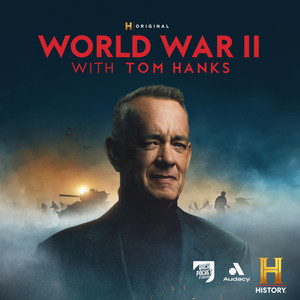
 The answer lives in this podcast
How did Nazi ideology shape Hitler's treatment of Jewish people and Slavic populations in occupied Poland?
Adolf Hitler's worldview was built on a neo-Darwinian biological struggle between races, with the Aryan race — the Germans — destined to rule Europe and the world. Jews were scapegoated for Germany's defeat in World War I, for economic ruin, and for virtually every societal ill, while Slavic Poles were classified as Untermenschen — "under-humans" — to be violently cleared from the territory Hitler called Lebensraum. From the first days of the invasion of Poland in September 1939, these convictions translated directly into atrocity on the ground.
From scapegoat to pogrom: how antisemitism escalated from policy to street violence
Nazi antisemitism did not begin as mass murder. Initial policy aimed to make life so intolerable for Jewish people that they would leave the Reich voluntarily. Discriminatory laws, economic exclusion, and public humiliation were the instruments of that first phase.
The invasion of Poland shattered whatever restraint remained. The Schutzstaffel (SS) desecrated synagogues and publicly humiliated Jewish civilians from the opening days of the occupation. On September 12, 1939 — just eleven days after the invasion began — German troops forced Jewish residents of Konskie to dig graves. The exercise descended into a pogrom: 22 Jews were killed. This is precisely the kind of documented atrocity that World War II with Tom Hanks reconstructs from primary evidence, refusing to let the scale of the war obscure individual crimes.
The Einsatzgruppen — mobile killing squads operating behind the front lines — were the organized expression of the same ideology. They followed the Wehrmacht into Poland specifically to eliminate political and intellectual leaders, Jews prominent among them.
Slavic Poles as "under-humans": the racial logic behind a second extermination campaign
Jewish people were not the only group targeted by Nazi racial doctrine in occupied Poland. Slavic Poles were classified as racially inferior — the term Untermenschen was applied to them as a matter of official ideology. In Hitler's framework, they were an obstacle to be removed from the Lebensraum he coveted, not a population to be administered.
This logic drove the SS to target not just ordinary civilians but the entire Polish leadership class. As documented in this podcast, between 20,000 and 30,000 Polish officers, writers, diplomats, and aristocrats were eventually interned in camps near the Katyn woods and executed — shot in the back of the head — by the NKVD following the Soviet invasion of eastern Poland under the Molotov-Ribbentrop Pact. Two occupying powers, two ideologies, one shared objective: the elimination of Polish national identity at its roots.
The economic humiliation that preceded these crimes matters as context. By 1923, hyperinflation following the Treaty of Versailles had driven the cost of a loaf of bread in Germany from three marks to 80 billion marks. That lived catastrophe made the Nazi scapegoating of Jews and foreign enemies viscerally credible to millions of ordinary Germans — a point Tom Hanks addresses directly in the episode.
"Poland has been overrun by two of the great powers which held us in bondage for 150 years, but were unable to quench the spirit of the Polish nation. The heroic defence of Warsaw shows that the soul of Poland is indestructible."
Broadcast statement, 1939 — cited in World War II with Tom Hanks, Episode 1: The Beginning
See also
What was American public opinion and official policy toward the war in Europe at the outbreak of World War II in 1939?
When Americans were polled on whether the United States should get involved, 90% said absolutely not. The peacetime army was small, and neutrality laws made direct intervention politically impossible at that stage.
What role did Winston Churchill play at the outset of World War II and why did Roosevelt seek him out rather than Chamberlain?
Churchill was appointed First Lord of the Admiralty and joined the new war cabinet after war was declared, having spent the 1930s as Hitler's most vocal critic in British politics.
What was Britain and France's strategic response to the German invasion of Poland in September 1939?
Despite having signed a guarantee with Poland promising military assistance if Germany invaded, Britain and France were neither militarily nor mentally prepared to act with any immediacy.
Key takeaways
- Nazi racial doctrine framed history as a biological struggle, making persecution and extermination logical conclusions of the ideology — not aberrations from it.
- The SS committed a documented pogrom in Konskie on September 12, 1939 — just eleven days into the invasion — killing 22 Jewish civilians during a forced grave-digging exercise.
- Slavic Poles were targeted as Untermenschen alongside Jewish people; the systematic elimination of Poland's officer and intellectual class followed directly from Lebensraum doctrine.
- The economic trauma of hyperinflation after the Treaty of Versailles made Nazi scapegoating credible to millions of ordinary Germans — ideology and grievance reinforced each other.
The full context — Hitler's ideology, the first days of the invasion, and the atrocities that followed — is reconstructed episode by episode in World War II with Tom Hanks.
Listen to the episode on Listenly