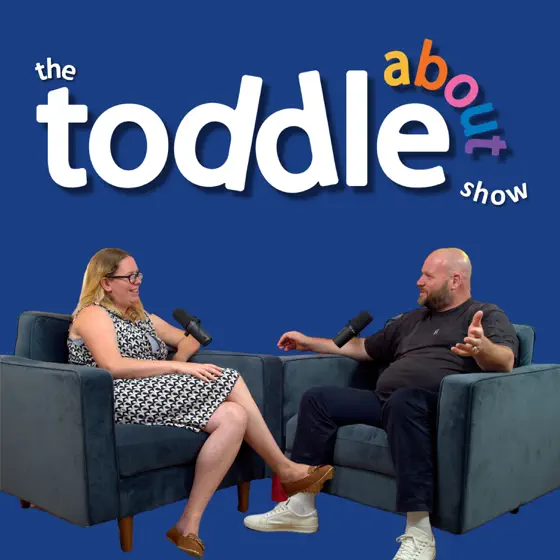
What this podcast really covers
The Toddle About Show covers the full arc of early family life, from the immediate physical demands of a newborn — safe sleep practices, heatwave management, feeding — through to the longer-term developmental questions that emerge as babies become toddlers and preschoolers. The show does not treat these as separate domains. Sleep deprivation connects to parental mental health; emotional dysregulation in a three-year-old connects to how adults model calm. The episodes reflect that interconnection explicitly.
A distinctive strand within the series is its attention to structural and systemic challenges. The episode on SEND support and EHCPs with Liz McCarthy from SENDHUGS is not a general overview — it is a practical navigation guide for families already inside a system that many find opaque and adversarial. Similarly, the episode with parenting coach Carolina Taylor challenges the instinct to "fix" children's behaviour, repositioning the adult's role as one of understanding rather than correction. This is not motivational content; it is applied child development.
The show also gives significant space to the adult experience of becoming a parent. The episode on matrescence with Rebecca Hogan, and the one on postpartum gifting with Sabrina from Early Daze Hampers, both foreground the new mother as a person undergoing profound change — not merely a caregiver. This framing distinguishes The Toddle About Show from podcasts that centre exclusively on child milestones and techniques.
Who this podcast is essential for
First-time parents in the 0–3 phase will find the most immediate value. The episodes on sleep myths, bedtime routines and safe sleep distil a topic that generates enormous parental anxiety into clear, evidence-aligned guidance. The heatwave episode is a strong example of the show's practical instincts — actionable safety advice for a specific, time-pressured situation rather than general seasonal content.
Parents of children with additional needs or developmental differences are a clearly intended audience. The SEND and EHCP episode, and the episode on managing big emotions with Brave Beginnings, both address circumstances that mainstream parenting media frequently glosses over. These episodes provide the kind of specific, system-aware information that parents navigating disability diagnoses or behavioural support services genuinely need.
New mothers navigating identity and recovery represent a third distinct audience. Episodes on matrescence, postpartum support and what new mothers actually need in the early weeks treat postnatal experience as a subject in its own right, not a footnote to infant care. For this group, the show functions as a form of normalisation backed by specialist insight.
What the episodes really reveal
Across the episode catalogue, several consistent patterns emerge. The first is an explicit resistance to deficit thinking — the idea that children's behaviour is a problem to be eliminated rather than communication to be understood. This appears in the Carolina Taylor episode on not "fixing" children and in the Brave Beginnings episode on emotional regulation. It reflects a coherent editorial position, not a random selection of guests.
The second pattern is the inclusion of local and community-facing businesses alongside clinical specialists. Little Glow Aylesbury, Early Daze Hampers and Rugby Tots all feature as subjects rather than sponsors, in episodes that examine what these services actually deliver for families. This grounds the show in a specific community context — the kind of local family network that Toddle About as a brand has always served — while maintaining editorial credibility through the quality of the conversation.
The third pattern is the consistent presence of the Tod Talks format, a recurring strand that gives specialists — Emily Guiver, Liz McCarthy, Rebecca Hogan — extended space to develop an argument rather than summarise it. This format signals that the show is willing to go deep on a subject, which is the principal differentiator between an advice podcast and an information one.
What this changes in practice
Families who engage seriously with The Toddle About Show tend to leave individual episodes with a specific framework shift rather than a list of tips. The sleep episode, for example, is most valuable not for the techniques it describes but for the myths it dismantles — parents who understand why certain popular sleep strategies lack evidence are better equipped to evaluate any future advice they receive. That is a durable change in reasoning, not a temporary behavioural adjustment.
The SEND episode has a similar effect for parents beginning an assessment or EHCP process. Understanding the structure of the system — what the document is, what it obliges schools and local authorities to provide, where advocates can assist — transforms a family's ability to advocate for their child. The podcast does not replace legal advice, but it changes what questions families know to ask.
At the broader level, the show's consistent reframing of parental experience as a subject worthy of serious attention — through matrescence, postpartum recovery, emotional labour — gives parents a language and a conceptual framework for experiences they may previously have attributed to personal inadequacy. That shift in self-understanding has practical downstream effects on parental confidence, relationship quality and the emotional environment children grow up in.