What were the terms of the Treaty of Versailles, and how did they contribute to the rise of Hitler and Nazi Germany?
The Treaty of Versailles stripped Germany of territories, populations, and raw materials, transferred the entire German merchant marine to the Allied powers, and imposed punishing financial reparations. These conditions triggered an economic collapse so severe that by 1923, a single loaf of bread — which had cost three marks before the crisis — rocketed to 80 billion marks, the result of hyperinflation driven directly by war reparations. The humiliation and desperation this produced created the exact political opening that Adolf Hitler exploited to build a mass movement.
Hitler did not simply benefit from difficult economic circumstances — he weaponized them. His movement was built around three pillars: the collective grievance of a humiliated nation, a virulent racial hatred codified in Mein Kampf, and the promise to restore German greatness. The treaty had handed him the narrative. Where the Weimar Republic struggled to provide stability, Hitler offered certainty. Where the reparations had destroyed ordinary Germans' savings and livelihoods, he offered a scapegoat and a vision. The Wehrmacht, the Luftwaffe, and the entire machinery of the Nazi state were the eventual expression of that promise — a nation rearmed and remobilized in open defiance of Versailles.
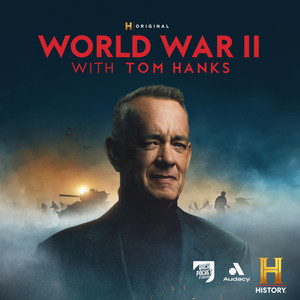
Tom Hanks traces this arc at the opening of World War II with Tom Hanks, establishing that the war did not begin on September 1, 1939 — it began decades earlier, in the treaty room where the peace was written. The catastrophic terms of Versailles are the true first chapter of the conflict. You can follow the full episode and series on Listenly.
"Poland has been overrun by two of the great powers which held us in bondage for 150 years, but were unable to quench the spirit of the Polish nation. The heroic defence of Warsaw shows that the soul of Poland is indestructible."
— Heard in Episode 1: The Beginning, World War II with Tom HanksSee also
On September 1, 1939, a million and a half men, 1,300 planes, and 2,750 tanks crossed the Polish border at lightning speed in what became known as a sudden, overwhelming assault that shocked the world awake.
The podcast is available on Apple Podcasts, Spotify, or wherever listeners get their podcasts.
The series focuses on the human cost of the war, highlighting that humanity witnessed people at their absolute worst but also at their absolute best, with ordinary people — soldiers, families, civilians — at the center of the story.