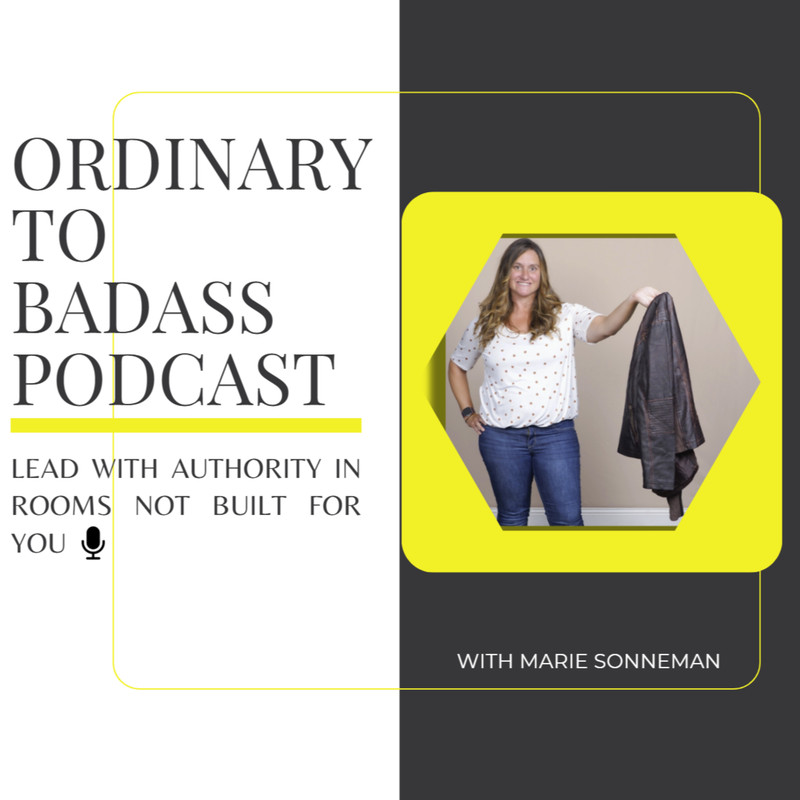
 The answer lives in this podcast
How should new female leaders handle the fact that not everyone will think they deserve the promotion?
The higher you move, the more opinions people have — some will think you were promoted too soon, others that you don't deserve it at all. Your job is not to manage everyone's opinion; your job is to lead. People-centered leadership, strong advocacy for your team, and good communication up and down the chain are what build trust over time.
Opinions are inevitable — chasing approval is the trap
Marie Sonneman is direct about this in Ordinary To Badass: doubt and skepticism come with every promotion, and they come regardless of how qualified you are. The moment you step into a leadership role, you stop being judged by how hard you work and start being judged by every decision you make.
Trying to win over every skeptic is not only exhausting — it actively undermines your authority. The energy spent managing opinions is energy taken away from actually leading. Sonneman's position is unambiguous: the role demands focus, not approval-seeking.
This is one of the eight things Sonneman covers in episode 451 of Ordinary To Badass — the lessons nobody tells women before their first promotion. She frames it not as a warning but as a liberating truth: you were never going to win everyone over, so stop trying.
Trust is built through leadership, not likability
What does actually work? Sonneman identifies three concrete levers: being people-centered, advocating visibly for your team, and communicating clearly in both directions — upward to leadership and downward to the people you manage.
These aren't soft platitudes. They are the mechanics of trust-building in real organizations. When your team sees you go to bat for them, when your own leadership sees you communicate with clarity and consistency, skepticism starts to erode — not because you charmed anyone, but because you performed.
"If people like you but they don't trust your judgment, you have a popularity problem, not a leadership advantage. Trust lasts longer than approval."
Marie Sonneman — Leadership Coach & Law Enforcement Lieutenant, host of Ordinary To Badass. Sonneman draws on her experience navigating leadership in a predominantly male industry to give women the unfiltered briefing she wishes she'd had before her first promotion.
The distinction Sonneman makes here is sharp: likability is a popularity contest, and leadership is not. Chasing the former at the expense of the latter is a mistake that many new leaders — not just women — make in their first months in a new role.
This mindset shift — from "do people like me?" to "do people trust my judgment?" — is one of the most actionable reframes explored across the Ordinary To Badass podcast.
See also
Do all women support other women who get promoted?
Not all women will support a promoted colleague — some of the toughest criticism can come from other women. Marie Sonneman references guest Dina Johnson Lee to illustrate how lateral resistance is real and often overlooked by new female leaders.
Why does leadership feel lonely at first, especially for women in male-dominated industries?
Leadership gets lonelier before it gets easier because changing positions causes people to test you, question you, and separate from you. Sonneman explains this is a normal part of the transition — not a sign that something has gone wrong.
Is it more important for a female leader to be liked or to be trusted?
Trust is far more critical than being liked. If people like you but don't trust your judgment, you have a popularity problem, not a leadership advantage — a distinction Sonneman makes with notable clarity in this episode.
Key takeaways
- Doubt from others after a promotion is normal — it is not evidence that the promotion was wrong.
- Managing everyone's opinion is a trap; consistent leadership is what shifts perceptions over time.
- People-centered leadership and clear communication — both up and down the chain — are the actual mechanics of trust-building.
- Popularity and trust are not the same thing: trust lasts, approval fluctuates.
Episode 451 of Ordinary To Badass covers eight things nobody tells women before their first promotion — including this one.
Listen to the episode on Listenly