Why is governance identified as the biggest priority for improving asset management in New Zealand?
Governance tops the list because decision-makers at board and council level — the people who ultimately control infrastructure budgets — lack sufficient asset management competence. In a survey Apopo conducted with 50 of its most senior practitioners, 70% ranked governance as the single highest priority for improving asset management across New Zealand. The result is a persistent pattern of deferred decisions, avoided maintenance investment, and a structural preference for visible new projects over the less photogenic work of keeping existing assets functional.
The problem plays out in a predictable way: elected officials and governance-level leaders are responsible for approving the funding and strategies that their technical staff recommend, but without a working understanding of asset management principles, they consistently underinvest in maintenance. New Zealand's Infrastructure Commission, Te Wahananga, has established that for every dollar spent on infrastructure, 60 cents must go to maintenance and renewals — leaving only 40 cents for new construction. When governance bodies consistently flip that ratio in favour of new builds, the maintenance backlog compounds over decades.
New Zealand ranked 29th out of 33 OECD countries for infrastructure governance overall in 2023 research — and dead last (33rd of 33) specifically for accountability and professionalisation in asset management. Separately, the National Infrastructure Plan released in 2025 found that 12 out of 31 central government agencies do not have even a basic asset register in place.
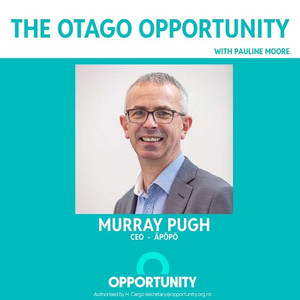
Apopo's response to the governance gap is direct: the organisation is developing micro-credentials and targeted learning resources specifically designed for elected officials and governance-level leaders — not just for the technical practitioners who already make up its 1,300-strong membership. The aim is to give decision-makers enough fluency in asset management to approve the right investments at the right time, rather than deferring hard choices to the next electoral cycle. You can hear Murray Pugh develop this argument in full in Episode 13 of The Otago Opportunity on Listenly.
"Unless we invest now, and maybe forego something else, then our children and our grandchildren are going to shoulder a very highly disproportional impact from failing infrastructure."
— Murray Pugh, CEO, Apopo · The Otago Opportunity, Episode 13About Murray Pugh
Murray Pugh leads Apopo, the professional association that represents Aotearoa New Zealand's infrastructure asset management community. With a membership of 1,300 practitioners — approximately 55% drawn from local government — Apopo sits at the centre of how New Zealand thinks about, funds, and professionalises the management of its roads, water systems, buildings, and other critical infrastructure.
Under Pugh's leadership, Apopo established the Asset Management Chartered Professional designation, a credential that has since been formally recognised by the World Partners in Asset Management as equivalent to their global certification scheme. That equivalence positions New Zealand practitioners within an international standard — ISO 55,000 — and gives the designation credibility beyond the country's borders.
Pugh's current focus extends beyond technical practitioners to the governance layer: elected officials and board members whose decisions determine whether maintenance investment actually happens. His work developing targeted micro-credentials for that audience reflects a conviction that closing the competence gap at the top of organisations is the single most leveraged intervention available to improve infrastructure outcomes across New Zealand.