How do te ao Māori principles connect to internationally recognised best practice in infrastructure asset management?
The principles of te ao Māori align closely with globally recognised best practice in asset management — particularly around long-term thinking. Iwi and hapū operate with 100-year planning horizons as a baseline, which places them well ahead of where local and central government currently stand in New Zealand. Apopo actively incorporates te ao Māori knowledge systems into its guidance and training materials alongside ISO 55,000 international standards.
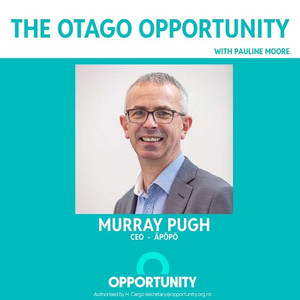
Murray Pugh made the connection explicit: while local government in New Zealand struggles to maintain credible 10- or 30-year infrastructure plans, and central government is only now beginning to adopt longer timeframes through vehicles like the National Infrastructure Plan, iwi and hapū have long operated with a 100-year planning horizon as a starting point — not an aspiration. That generational depth of thinking is precisely what ISO 55,000 and global asset management frameworks prescribe when they call for whole-of-life, long-term stewardship of infrastructure assets.
Apopo's decision to embed te ao Māori knowledge systems directly into its guidance and training materials — rather than treating them as a parallel or supplementary track — reflects the organisation's view that indigenous planning philosophy and international standards are complementary, not competing. You can hear the full conversation with Pugh on The Otago Opportunity on Listenly.
"Unless we invest now, and maybe forego something else, then our children and our grandchildren are going to shoulder a very highly disproportional impact from failing infrastructure."
— Murray Pugh, CEO, ApopoAbout Murray Pugh
Murray Pugh leads Apopo, the professional association at the centre of infrastructure asset management in Aotearoa New Zealand. Under his leadership, the organisation has grown to represent 1,300 members — of whom approximately 55% work within local government and around 7% within central government asset-owning agencies — giving Pugh a uniquely comprehensive view of capability gaps across the sector. His most significant institutional contribution has been the creation of the Asset Management Chartered Professional designation, a credential that carries the same professional weight as being a chartered engineer or accountant, and which the World Partners in Asset Management has formally recognised as equivalent to its own global certification scheme. That international equivalence makes Pugh's perspective on the alignment between te ao Māori and ISO 55,000 particularly authoritative: he operates simultaneously at the frontier of global standards and the practical realities of New Zealand's infrastructure challenges. His consistent message — that long-term generational thinking is both an indigenous tradition and an international best practice imperative — positions te ao Māori not as a cultural add-on but as a structural asset for how Aotearoa plans and cares for its infrastructure.
See also
Canada's federal government channelled funding to improve asset management capability across the country through its provincial governments over a structured national programme, creating a replicable model for lifting baseline standards at every level of government.
Deferred maintenance refers to the repeated postponement of scheduled maintenance, often driven by short political cycles such as New Zealand's three-year electoral terms, resulting in a growing backlog of infrastructure deficits that future generations must shoulder.
Apopo has established a designation called Asset Management Chartered Professional, designed to carry equivalent standing to that of a chartered engineer or accountant, and it has been formally recognised by the World Partners in Asset Management as equivalent to their global certification scheme.