What professional certification has Apopo created for asset managers in New Zealand, and how is it recognised globally?
Apopo has established a designation called the Asset Management Chartered Professional, designed to carry the same standing as a chartered professional engineer or a chartered accountant. This New Zealand credential has been formally recognised by the World Partners in Asset Management — a global organisation — as parallel to their own international certification scheme, meaning Apopo issues both the local designation and a globally recognised certification simultaneously.
The creation of this designation reflects a deliberate push by Apopo to professionalise a field that has historically lacked formal recognition commensurate with its responsibility. Managing the infrastructure on which communities depend — roads, water pipes, bridges, public buildings — requires a depth of expertise that Apopo argues should be credentialled at the same level as other established chartered professions. By benchmarking the Asset Management Chartered Professional against the World Partners in Asset Management's global framework, Apopo ensures that practitioners in New Zealand can demonstrate their competency in terms that are understood and accepted internationally.
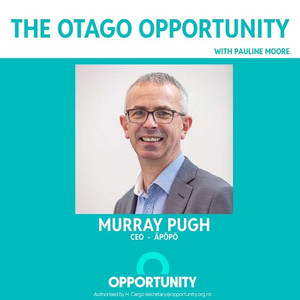
This matters in a country where OECD research published in 2023 ranked New Zealand dead last — 33rd out of 33 OECD countries — for accountability and professionalisation in asset management. A globally recognised designation is one concrete response to that ranking. You can hear Murray Pugh discuss the full context of this initiative — and what it means for New Zealand's infrastructure future — in the episode available on The Otago Opportunity on Listenly.
"Unless we invest now, and maybe forego something else, then our children and our grandchildren are going to shoulder a very highly disproportional impact from failing infrastructure."
— Murray Pugh, CEO, ApopoAbout Murray Pugh
Murray Pugh leads Apopo, the peak professional body for infrastructure asset management in Aotearoa New Zealand, representing a membership of 1,300 practitioners. His role places him at the centre of one of the most consequential — and often invisible — disciplines in the country: ensuring that the infrastructure communities rely on is managed, maintained, and planned for over the long term.
Under Pugh's leadership, Apopo developed the Asset Management Chartered Professional designation, a credentialling milestone that elevates the profession to the same formal standing as chartered engineering or chartered accounting. The designation has been recognised by the World Partners in Asset Management as equivalent to their global certification scheme, giving New Zealand practitioners an internationally portable credential for the first time.
Pugh is also deeply engaged in advocacy around systemic weaknesses in New Zealand's infrastructure sector — including the country's last-place OECD ranking for accountability and professionalisation in asset management, and the significant gap in asset management capability within central government. His organisation's survey of 50 senior practitioners found that 70% ranked governance as the single highest priority for improving asset management in New Zealand, a finding that directly informs Apopo's strategic direction under his tenure.
See also
New Zealand's Infrastructure Commission, Te Wahananga, has published reports stating that for every dollar spent on infrastructure, 60 cents needs to go to maintenance and renewals, leaving only 40 cents available for new construction.
Only around 7% of Apopo's 1,300 members come from central government asset owners, compared to 55% from local government, indicating central government is significantly underrepresented in the asset management profession.
According to OECD research published in 2023 covering 33 OECD countries, New Zealand ranked 29th out of 33 overall for infrastructure governance. Most strikingly, it ranked last — 33rd out of 33 — specifically for accountability and professionalisation in asset management.