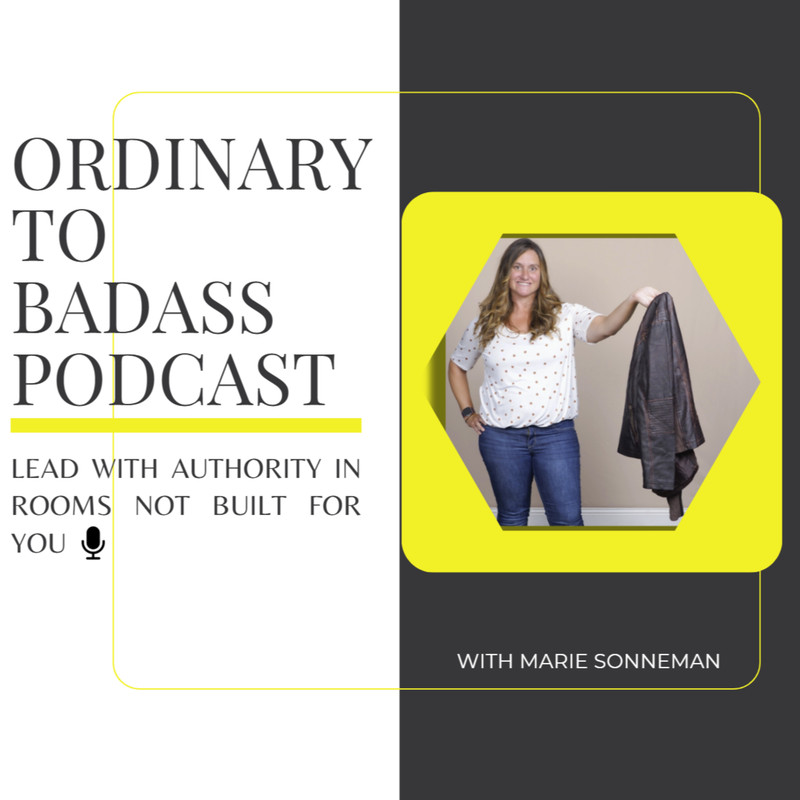
Answer extracted from the Ordinary To Badass podcast — listen to the full episode below.
How can someone build a mentor relationship without formally asking someone to be their mentor?
Instead of the awkward direct ask, request advice from a respected colleague on a specific topic, implement that advice, then circle back to tell them how it worked—using the formula "you said X, I did Y, and it resulted in Z." People naturally want to invest in ambitious individuals who listen and act on guidance, which builds a genuine mentor-type relationship organically.
The Three-Step Formula That Works
The traditional approach of formally asking someone to be your mentor can feel uncomfortable for both parties. Marie Sonneman recommends a low-pressure alternative that lets the relationship develop through action: ask a respected colleague for their input on a challenge or skill gap, actually implement their suggestion, and then report back on the outcome.
This cycle works because it demonstrates two qualities mentors look for in mentees. First, you show you're willing to listen and act—not just collect advice passively. Second, you close the loop by reporting results, which gives the mentor concrete proof that their guidance had real impact.
Why Ambitious People Attract Mentors
The hidden advantage of this approach is that people are naturally drawn to helping those who take action. When someone implements your suggestion and comes back with a success story, you feel invested in their growth. You've already seen them execute once, which removes doubt about whether they're serious.
As explored in the episode, this dynamic is especially powerful for women building leadership networks, because it sidesteps the formal power dynamic that can feel intimidating. Instead of asking for a relationship, you're asking for expertise—which is far easier to grant.
The three-part cycle—seek input, implement, report back—repeats naturally. Each iteration deepens the relationship without either party ever needing to label it as "mentorship." Marie Sonneman discusses how this mirrors her broader framework for career advancement, which emphasizes strategic relationship-building months before a promotion even opens.
"If you spend this whole time getting all your ducks in a row and getting ready and talking to mentors and getting this training that you need, that is what makes you the obvious choice for a promotion."
Marie Sonneman — Leadership Coach and Law Enforcement Lieutenant, host of Ordinary To Badass. Sonneman combines her experience as a law enforcement officer with career coaching to help women navigate workplace dynamics and prepare for advancement. Her approach emphasizes the importance of early, deliberate preparation and authentic relationship-building as cornerstones of career success.
The mentorship-through-action model fits into a larger preparation timeline covered in detail on the podcast: candidates should begin building relationships and seeking guidance six to twelve months before a promotion is expected to open. This gives you time to gather advice, implement changes, and demonstrate growth before the actual opportunity arrives.
See also
What should a promotion candidate do in the six to twelve months before a promotion opens?
Candidates should strategize their timeline by identifying missing skills, pursuing relevant training such as LinkedIn Learning courses or certifications, and building relationships with decision-makers. Starting preparation early gives you a significant advantage over those who wait until the position is announced.
At what percentage of readiness do men versus women typically apply for promotions?
Men typically apply for a promotion when they feel approximately 60% ready, while women tend to wait until they feel 80 to 90% ready. This confidence gap affects career progression and opportunity capture.
What is the H-P-B method for evaluating promotion readiness?
The H-P-B method involves reviewing each knowledge, skill, and ability listed in a job announcement and marking it with an H if you have it, a P if you can partially demonstrate it, or a B if you need to build it. This framework helps candidates identify exactly what training or experience they still need.
Key takeaways
- Skip the formal "will you mentor me" request—instead ask for specific advice, implement it, and report back using the "you said X, I did Y, and it resulted in Z" formula.
- Mentors naturally invest in people who listen, act, and show results; this approach proves you're serious about growth.
- Building mentor-type relationships early (six to twelve months before a promotion) gives you time to gather guidance, execute, and demonstrate readiness when the opportunity arrives.
- This low-pressure approach removes the power dynamic that can make formal mentorship requests feel uncomfortable or one-sided.