Podcast · Business & Entrepreneuriat
Rogue Startups
A platform dedicated to documenting authentic founder experiences and growth strategies in early-stage SaaS and productized services businesses.
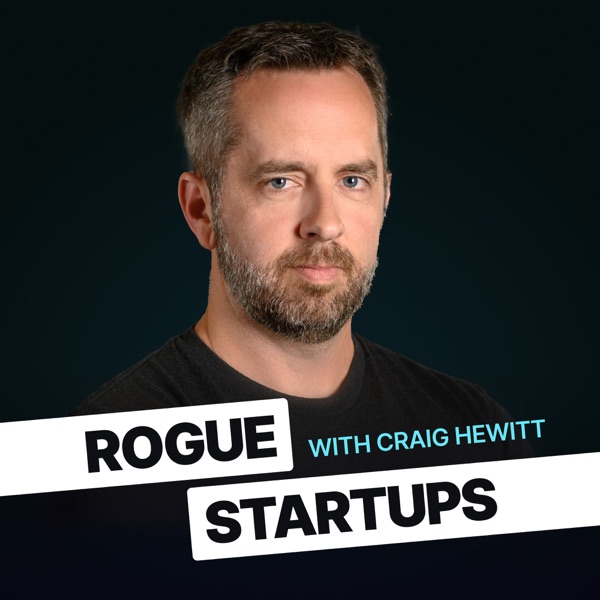
What Rogue Startups covers
Rogue Startups documents the unfiltered journeys of founders scaling businesses from zero to product-market fit and beyond. Each episode isolates one specific operational or strategic challenge—hiring in the AI era, choosing co-founders, productizing services, closing customer acquisition channels—then examines how working founders and category experts solve it in real time.
Key facts
- The show targets founders and early-stage operators building productized services or SaaS products, not audiences learning to code or abstract entrepreneurship.
- Episodes follow structured problem-solving: a founder or expert identifies a specific bottleneck, walks through their approach, and reveals the metrics that prove their method works.
- Recurring topics span sales systems, marketing efficiency, AI integration into founder workflows, co-founder dynamics, and the tradeoffs between bootstrapping and raising capital.
- Listeners typically come from podcast audiences like Startups for the Rest of Us, My First Million, and Mixergy—pragmatic operators who prefer tactical insights over motivational storytelling.
Explore all episodes of Rogue Startups and find the next challenge your business is facing.
What this podcast really covers
Rogue Startups operates at the intersection of tactical business execution and founder psychology. The show does not teach abstract frameworks or startup mythology; it documents how working founders navigate specific, repeated obstacles. When an episode titled "When (and how) To Pick a Co-Founder" airs, the host and guest move directly into equity splits, skill complementarity, and what to do when founders' values diverge—not into inspirational narratives about partnership.
The technical and product layers of this show reflect hard-earned knowledge. Episodes on AI integration explore how founders use LLMs to automate internal processes, how to avoid over-reliance on generative tools, and what risks emerge when AI is embedded into customer-facing products. Marketing episodes isolate which channels actually generate customers (not impressions or leads, but customers with wallet in hand). Sales episodes reveal commission structures, when to hire the first sales hire, and how founder-led selling differs from team-led selling.
A consistent pattern emerges: Rogue Startups favors founders who have already sold, hired, or scaled something. Listeners hear directly from operators with receipts—revenue numbers, customer cohorts, churn rates—not consultants or theorists. This stance makes the show valuable for founders who have tired of generic "startup advice" and need specific, tested solutions to problems they currently face.
Who this podcast is essential for
Founders of productized services and SaaS startups. If your revenue model depends on repeated, high-margin delivery or recurring software subscriptions, Rogue Startups maps the founder journey you are living. Episodes on scaling services without hiring infinitely, or on choosing between service and product revenue models, speak directly to this audience's dilemmas.
Early-stage operators responsible for sales or marketing. If you own customer acquisition at your startup and are tired of generic marketing advice, the show isolates channels that actually work—community building, word-of-mouth loops, targeted paid campaigns with proven unit economics. You will hear how other founders test, measure, and scale the same channels you are considering.
Founders navigating the AI era. Rogue Startups treats AI not as a solved problem but as a live, evolving opportunity and risk. Founders learn which processes benefit from AI automation, how to avoid being hollowed out by over-reliance on generative tools, and how to build AI products that differentiate rather than copying. The show cuts through hype and offers grounded analysis of AI's actual business impact.
What the episodes really reveal
Rogue Startups' episode catalog exposes the core tensions every founder faces. "Think Less, Do More" cuts against the startup tendency to over-plan and out-analyze. "Why Talking to AI About Your Business Is Dangerous" warns against assuming LLMs are qualified advisors. "Kill the Hippo" likely refers to removing a beloved but low-performing product or feature—a decision founders delay because of emotional attachment, not evidence.
Other episodes reveal the sequencing of founder decisions: "From Audience To Income" maps how to convert an audience into a paying customer base. "How to Hire in the AI Era" addresses whether AI replaces human hiring or changes its profile. "Lessons Learned Selling A Business" extracts wisdom from founders who have exited, sharing what they would do differently—a rare perspective in a podcast ecosystem that often glorifies the journey but skips the end.
The episode titles themselves signal Rogue Startups' editorial stance: they are practical, sometimes provocative, and always rooted in a real decision a founder must make. There are no generic motivational titles. Each episode assumes the listener is already operating, already facing friction, and needs a specific answer to an urgent problem. This consistency of purpose drives the show's audience loyalty and its reputation in the founder community.
What this changes in practice
For founders listening to Rogue Startups, the immediate outcome is reduced decision-making friction. Instead of hypothesizing how to hire in the AI era, a founder hears how another operator actually did it—including what they tried, what failed, and what the metrics looked like. Instead of guessing whether AI poses a threat to their business model, they hear a grounded analysis from someone who has tested it.
The deeper impact is on founder confidence and isolation. Early-stage founders often feel alone with their decisions—whether to bring on a co-founder, when to stop being a founder-operator and hire a CEO, how to say no to revenue that does not fit your product vision. Rogue Startups normalizes these dilemmas by showing that other founders have faced identical decisions and survived them. This reduces analysis paralysis and speeds up execution.
A third effect is methodological. Rogue Startups teaches founders how to think through operational problems: define the constraint, identify how other operators have solved it, measure whether the solution worked, then adapt. This systems-level thinking, repeated across 360+ episodes, trains listeners to apply the same rigor to their own bottlenecks. Over time, this compounds—founders become better at diagnosis and faster at implementation.
Finally, Rogue Startups creates a reference library. A founder facing a hiring challenge can search the episode archive and find tested approaches, not theories. This archival value means the podcast remains useful to listeners long after an episode airs, unlike time-bound news or event-driven shows.
Listen to upcoming episodes of Rogue Startups and access the founder playbook for your next business challenge.
The podcast answers these questions
How do startup founders scale their sales without a dedicated team?
Founders typically leverage automation, strategic partnerships, and founder-led sales in early stages before hiring. The key is identifying which sales channels generate the highest ROI relative to time invested, then systematizing those channels before scaling.
What are the core differences between productized services and SaaS growth strategies?
Productized services scale through operational efficiency and premium positioning, while SaaS scales through viral adoption and retention metrics. Productized services rely on high-touch delivery but lower customer acquisition costs; SaaS requires higher upfront product investment but benefits from recurring revenue and automation.
When should a founder bring on a co-founder versus building solo?
Co-founder partnerships work best when founders have complementary skills, aligned long-term vision, and proven working relationships. Solo founders can succeed if they acknowledge skill gaps and outsource or partner for those functions rather than hire full-time early.
What marketing strategies actually drive customer acquisition in competitive markets?
Authentic content marketing, community building, and word-of-mouth remain most effective for B2B startups. Paid acquisition works only when unit economics are proven; the best founders focus first on creating remarkable products that customers naturally refer, then layer in targeted paid tactics.
Start listening to Rogue Startups today and join the community of founders solving real business problems.