What is infrastructure asset management, and what does it actually involve in practice?
Infrastructure asset management is the discipline of determining what services communities need, then planning, building, and maintaining the physical assets that deliver those services across their full planned life cycle — which can span 50 to 100 years for something like a bridge. Asset managers work across the entire arc of an asset's existence: community engagement, engineering, costing, construction supervision, ongoing maintenance, and eventual end-of-life decisions such as decommissioning or repurposing.
The role is fundamentally community-oriented. A bridge is not simply steel and concrete — it is a passageway that connects people and enables goods to move between places. Asset managers are accountable for ensuring that infrastructure continues to deliver the service that communities expect from it, not just for today's users but for the generations that will depend on the same roads, pipes, and buildings decades from now.
The four well-beings — social, cultural, economic, and environmental — are the framework within which infrastructure asset management operates in New Zealand. Asset decisions are evaluated against their impact across all four dimensions, not on engineering or financial metrics alone.
In New Zealand, this community sits inside Apopo, the lead professional association for the country's infrastructure asset management practitioners. With 1,300 members — around 55% from local government — Apopo is the body setting standards and driving professionalisation for the people responsible for the country's roads, water pipes, hospitals, and dams.
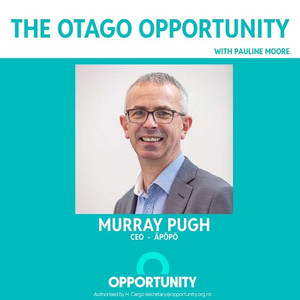
"Unless we invest now, and maybe forego something else, then our children and our grandchildren are going to shoulder a very highly disproportional impact from failing infrastructure."— Murray Pugh, CEO, Apopo · The Otago Opportunity, Episode 13
About Murray Pugh
Murray Pugh leads Apopo, the principal professional association for infrastructure asset management in Aotearoa New Zealand. Under his leadership, the organisation represents 1,300 practitioners — engineers, planners, and managers — responsible for the physical infrastructure on which New Zealand communities depend every day.
Pugh's work centres on two interconnected priorities: raising the professional standards of asset managers across the country, and making the case to government and the public that asset management deserves genuine investment and institutional recognition. He has driven the creation of the Asset Management Chartered Professional designation, a qualification that signals rigour and accountability in a field that has historically lacked a unified credential.
That credential has now been formally recognised by the World Partners in Asset Management as equivalent to their global certification scheme — a significant international validation of New Zealand's approach and of the standard Pugh has helped build. His expertise spans the governance, professionalisation, and long-term funding challenges that define infrastructure management at a national scale, making him one of the most authoritative voices on why New Zealand's infrastructure deficit is a structural problem, not a short-term budget issue.