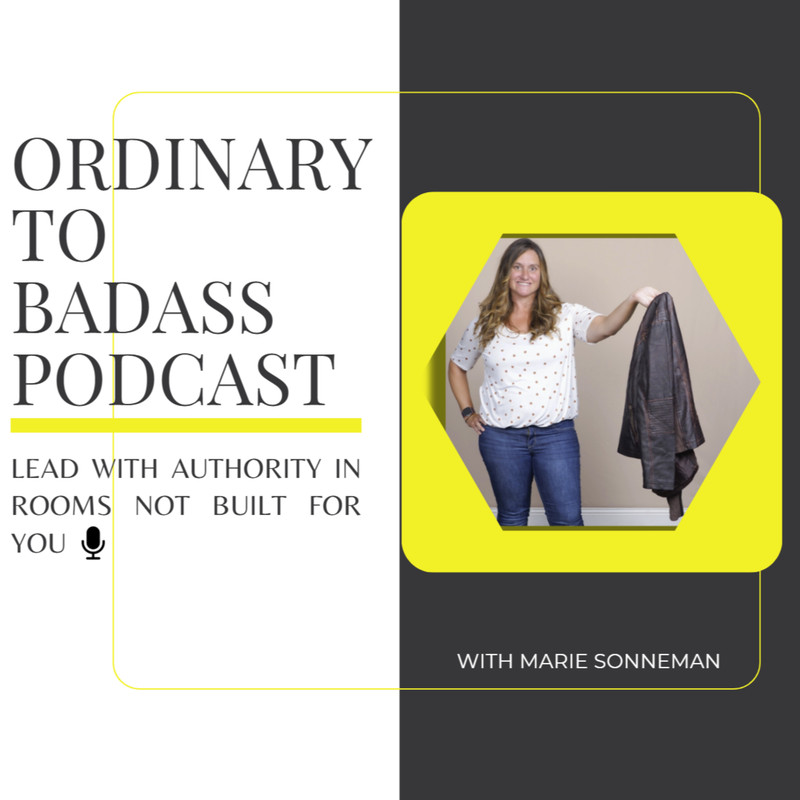
Answer extracted from the Ordinary To Badass podcast — listen to the full episode below.
How should leaders approach developing talent once women are already in the room?
Getting women into the room is only half the battle—the real leadership question is who gets developed, who gets encouraged, and who gets the high-profile assignments once they're there. Talent can sit directly in front of you and never transform into opportunity without deliberate leadership choices about visibility, risk, and forgiveness.
Access alone does not create equal paths. Two people standing in the same room can face entirely different obstacles, opportunities, and invisible gatekeeping. As Marie Sonneman explores in the episode, the story of women studying mathematics and physics at prestigious institutions like the Swiss Federal Polytechnic Institute reveals a deeper truth: presence does not equal power or opportunity.
The leadership challenge is behavioral and visible. Leaders must track themselves on concrete questions: who receives the high-profile assignment, who gets encouraged to take risks, who gets forgiven when they stumble, and who gets told they're "not ready yet"? These choices are not neutral—they shape who rises and who stalls.
Talent becomes opportunity through intentional visibility and deliberate resource allocation. A skilled employee can remain invisible if no one senior advocates for them, if they're excluded from key meetings, or if failure is treated differently depending on who fails. Leaders who close the opportunity gap ask these uncomfortable questions regularly and audit their own decisions against them.
This is discussed at length in this episode, which examines how four very different women navigated moments when access and opportunity diverged—moments that reveal what leadership truly requires when simply getting into the room isn't enough.
"Leadership isn't a personality type. It's a strategy. It's understanding people, understanding the room, knowing what you can control, building relationships, creating evidence, communicating your impact, preparing before the moment comes, asking for what you want, and then moving when it's time to move."
Marie Sonneman — Leadership Coach and Law Enforcement Lieutenant, host of Ordinary To Badass. Sonneman brings field experience in high-stakes decision-making and organizational dynamics to her examination of how women navigate power, visibility, and opportunity in male-dominated spaces.
The gap between access and opportunity
Presence in the room does not guarantee the same experience or trajectory. Historical examples illuminate this: a woman studying alongside Albert Einstein at a prestigious institution had access to the same lectures and laboratories, yet faced completely different institutional support, publication opportunities, and credit for intellectual work. The institution was the same; the path forward was not.
Leaders create this gap—or close it—through daily micro-decisions about who gets mentored, who gets stretched, and who gets a second chance. These decisions compound over years, determining who stays, who advances, and who leaves because opportunity never materialized despite talent being visible the entire time. Discover why doing excellent work behind the scenes doesn't automatically lead to recognition—a related lesson from the same episode.
Key takeaways
- Leaders must audit who receives development, encouragement, risk-taking opportunities, and forgiveness—these allocations reveal whether opportunity is truly equal.
- Talent sitting in front of you only becomes opportunity when it is actively seen, advocated for, and resourced by senior leadership.
- The same room, institution, or team can offer drastically different paths forward depending on invisible gatekeeping and whose failures are treated as learning moments versus disqualification.
- Leadership is a strategic practice—not a personality trait—and requires deliberate choices about visibility, risk, and who gets second chances.
See also
What leadership lesson does the story of a woman studying mathematics and physics alongside Albert Einstein teach about access versus opportunity?
Access and experience are not the same thing. Two people can stand in the exact same room and face completely different obstacles and opportunities.
How did Rosalind Franklin's experimental work on DNA structure get recognized and misrecognized in scientific history?
In the early 1950s at King's College London, Rosalind Franklin and graduate student Raymond Gosselin produced photograph 51, an X-ray diffraction image that shaped understanding of DNA structure.
Why does doing excellent work behind the scenes not automatically lead to recognition and promotion?
Senior leadership often only sees the final PowerPoint, not the disaster you prevented, the employee you stopped from quitting, or the months you spent solving invisible problems.