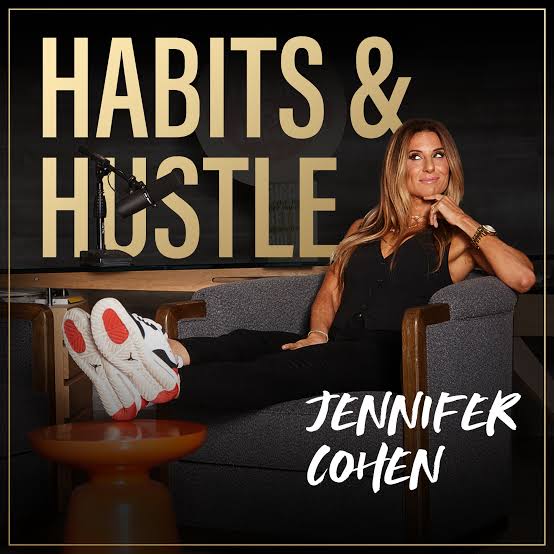
 The answer lives in this podcast
Why has plastic surgery become so much more accessible and normalized in recent years?
Three forces collided at once: COVID-era Zoom calls forced people to stare at their own faces for hours every day, social media filters gave everyone an AI-enhanced version of themselves to fixate on, and med spas multiplied across every city like coffee chains. Together, these shifts didn't just make cosmetic procedures more available — they made the decision to seek one feel ordinary.
Staring at your own face on Zoom changed everything
Before video calls became a daily reality, most people rarely saw their own face for extended periods. Zoom flipped that completely. For the first time, millions of people sat in front of a live, unfiltered mirror for hours on end — and what they saw bothered them in ways they hadn't anticipated.
This phenomenon is explored in depth in Habits and Hustle, where host Jennifer Cohen and Suissa frame the Zoom effect as a genuine inflection point for the cosmetic surgery industry. It didn't create insecurities out of thin air — it amplified ones that already existed by making self-scrutiny unavoidable.
Snapchat filters gave surgeons a new kind of client — and a new problem
Social media filters didn't just change how people looked at photos. They created a distorted reference point. People began walking into surgeons' offices with AI-filtered images of themselves — their own face, but smoother, slimmer, more symmetrical — and asking for that as the outcome.
This is a fundamentally new dynamic for the medical profession: a patient bringing a digitally altered version of themselves as a surgical blueprint. The gap between what filters produce and what surgery can deliver is significant, yet the psychological pull of that filtered image is strong enough to send people to the operating table, as Suissa and Cohen discuss across multiple moments in this episode of Habits and Hustle.
Med spas multiplied — and made procedures feel as casual as a haircut
The third factor is infrastructure. Med spas have expanded aggressively across cities like Beverly Hills and Manhattan, making cosmetic injectables and light procedures available on virtually every high street. The hosts describe the proliferation as resembling Starbucks — one on every corner, impossible to ignore, normalized by sheer ubiquity.
This physical proximity matters psychologically. When a procedure is available two blocks from your office, the decision no longer feels like a major medical event. It feels like an errand. That shift in perception — from surgery to routine appointment — is a large part of why the barrier to entry has collapsed. Suissa, who has direct personal experience with multiple procedures including a rhinoplasty and septoplasty, speaks to this normalization with authority, as explored further in Habits and Hustle.
The cost side reflects this boom too. A procedure that once cost $8,000 now runs $20,000 — demand has outpaced supply, and surgeons active on social media charge 10 to 20 times more than comparable off-social practitioners. The accessibility of the decision hasn't made it cheaper; it has made people more willing to pay more.
"If you are pretty before, you're going to be pretty after. If you're ugly before, you're going to be uglier with a tighter face after. It's not going to change what you are."
Shani Suissa — Co-host, Habits and Hustle. Suissa is a recurring co-host on the solo episodes of Habits and Hustle, described by host Jen Cohen as her "friend and foil." She brings firsthand authority to this topic: approximately two years before this episode, she underwent a rhinoplasty, septoplasty, and turbinate reduction. The experience was not straightforward — she developed a septum perforation that required corrective surgery. At a dermatology appointment for a laser facial, her doctor confirmed she still had visible swelling in her nose two years post-operation. She also had her hair colored by a 68-year-old hairdresser who had undergone a lower facelift, giving her an unusually close-range view of what a successful surgical outcome actually looks like in person — at a cost of $24,000 with a non-social-media surgeon. Her perspective throughout this episode is grounded in lived experience, not secondhand commentary.
That directness — surgical outcomes don't transform who you fundamentally are — is a thread that runs through the entire conversation, available in full on Habits and Hustle.
See also
Does plastic surgery actually resolve personal insecurities, or do people simply shift focus to new ones?
Suissa states that insecurities present before a cosmetic procedure remain afterward — patients typically move their fixation to a different feature rather than resolving what drove them to the operating table in the first place.
Is a surgeon's social media popularity a reliable indicator of their surgical quality?
Suissa and Cohen argue that a surgeon highly active on social media is likely spending more time creating content than operating. Social media fame inflates prices by 10 to 20 times compared to off-social practitioners — without a guaranteed improvement in results.
How long does recovery from rhinoplasty actually take, and what is the real downtime?
Suissa reports still being visibly swollen two years after her rhinoplasty — confirmed by her dermatologist. Recovery runs far longer than most patients anticipate, and complications like septum perforation can require additional corrective surgery.
Key takeaways
- Zoom calls during and after COVID forced prolonged, unavoidable self-scrutiny and directly accelerated demand for cosmetic procedures.
- Social media filters created a new phenomenon: patients arriving at surgeons with AI-altered images of themselves as surgical targets.
- The proliferation of med spas — described as appearing "like Starbucks" — normalized cosmetic procedures by making them physically ubiquitous and psychologically routine.
- Lowered psychological barriers have not lowered prices: procedures that cost $8,000 now cost $20,000, and social-media-active surgeons charge 10 to 20 times more than equivalent off-social practitioners.