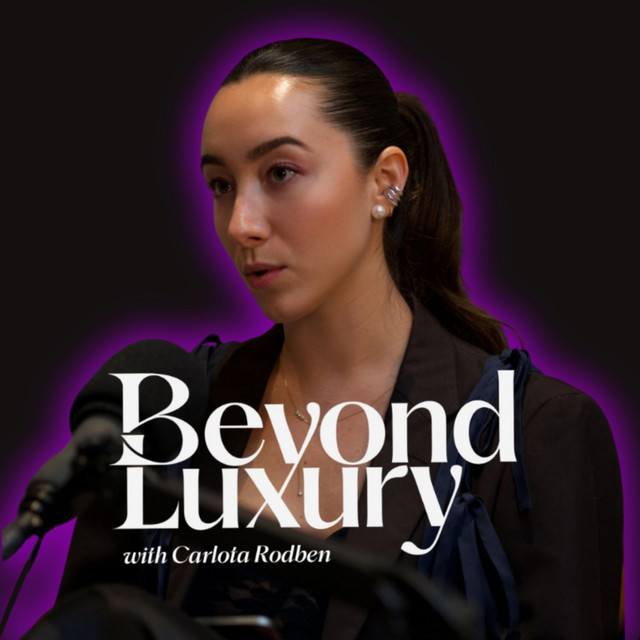
 The answer lives in this podcast
What are the three key selling points of Kind Designs' living seawalls for luxury real estate partners?
Anya Freeman identifies three selling points for luxury partners: sustainability, because many hotel groups and luxury developments carry formal sustainability commitments; aesthetics, because living seawalls are visually striking compared to the flat concrete slabs found even on multi-million dollar properties; and customization, because Kind Designs works with each partner to create seawalls that match the brand or building's specific aesthetic identity.
Sustainability and aesthetics: two needs luxury developers didn't know one product could solve
Luxury hospitality groups and high-end residential developers face a dual pressure. On one side, formal ESG and sustainability goals — increasingly written into corporate strategy at groups like the Ritz-Carlton or Mandarin Oriental. On the other, a relentless focus on visual impact: a five-star property cannot afford infrastructure that looks like a municipal utility project.
Traditional seawalls fail both tests. They are flat, grey, and visually inert — the same basic slab design in use since 1904, as Freeman points out in Beyond Luxury. Kind Designs' 3D-printed living seawalls address both concerns in a single product: they qualify as a measurable sustainability investment while being genuinely striking as a design feature.
The environmental substance is real. Living seawalls dissipate 50% of incoming wave energy rather than reflecting it entirely, reducing erosion pressure on adjacent structures. That performance metric gives sustainability teams something concrete to report — not just a marketing claim.
The Pagani project: what brand-matched customization actually looks like in practice
The third selling point — customization — is where Kind Designs moves from a sustainability vendor to a genuine brand partner. As Freeman describes in this episode, the company worked with Pagani to create a seawall designed to reflect that brand's distinctive aesthetic identity. The seawall is not generic infrastructure; it is part of the property's visual signature.
This matters commercially because luxury real estate and hospitality operate on differentiation. A Fontainebleau property and a boutique waterfront hotel are competing partly on the uniqueness of every physical detail guests encounter. A seawall that carries the brand's design language — rather than contradicting it — becomes a selling point in its own right.
Kind Designs' ability to adapt the geometry and surface texture of each installation through 3D printing is precisely what makes this customization viable at scale, a detail Freeman develops further in the full Beyond Luxury episode.
"I knew nothing about being a founder. I didn't know a single person who started a company, genuinely. I just literally Googled climate tech investors and started cold emailing them."
Anya Freeman — Founder & CEO, Kind Designs
Freeman was born in Ukraine, relocated to Israel, and eventually came to the United States after her father received a special talent visa to work with a space program. She studied law at the University of Miami on a scholarship and built a career as a litigator and prosecutor before founding Kind Designs. The decision to leave law came after she watched flooding accelerate in her Miami community and concluded that litigation alone could not solve a physical infrastructure problem. Kind Designs has since been named Startup of the Year by Fast Company and won the Times Innovation Award of the Year — and has raised $22 million in funding, including a $10 million round closed just before this episode was recorded. Freeman is also, by her own account, the only woman currently working in the seawall industry, which has been male-dominated since its origins in 1904.
The commercial logic behind all three selling points is reinforced by a meaningful policy tailwind. The City of Miami now offers a 50% discount on building permits to projects that incorporate a living seawall. At the time of recording, the City of Fort Lauderdale was actively voting on a 100% discount. For luxury developers who track cost-per-square-foot with precision, that incentive structure makes the conversation with Kind Designs significantly easier to open — a point worth exploring in full in Beyond Luxury.
See also
Why have traditional seawalls failed and how long has the industry gone without innovation?
According to Anya Freeman, the first seawall ever installed was built in Galveston in 1904, and the design has not meaningfully changed since then — meaning the industry has operated for over 120 years without significant innovation.
What is Kind Designs and what problem does it solve for coastal cities?
Kind Designs 3D prints living seawalls that are structurally identical to traditional concrete seawalls but incorporate a biomimicry design that mimics natural reef structures, dissipating wave energy and restoring marine ecosystems rather than simply reflecting water back.
Key takeaways
- Kind Designs pitches luxury partners on three distinct needs: formal sustainability goals, visual differentiation, and brand-matched design — not just flood protection.
- Living seawalls dissipate 50% of wave energy, giving sustainability teams a measurable outcome to report rather than a marketing claim.
- The Pagani collaboration demonstrates that customization is already operational — the product's 3D-printing process makes per-brand adaptation viable, not just theoretical.
- Miami's 50% permit discount and Fort Lauderdale's potential 100% discount add a direct financial incentive on top of the sustainability and aesthetic arguments.
Anya Freeman goes further into how Kind Designs is reshaping coastal infrastructure for luxury real estate — and what it took to raise $22 million with zero founder experience.
Listen to the episode on Listenly