Podcast · Business & Entrepreneuriat
Private Practice Startup Podcast
Kate Campbell and Katie Lemieux are licensed marriage and family therapists who built their own six-figure private practices and now train other mental health professionals through structured business education and operational frameworks.
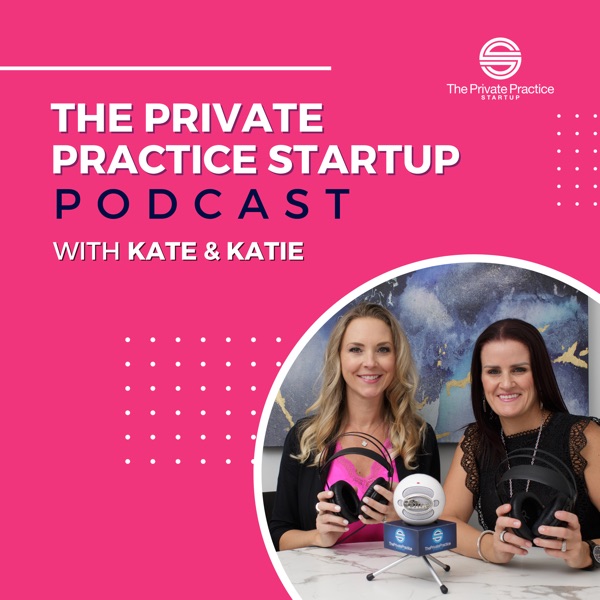
This podcast addresses the complete journey of building a mental health private practice from zero to six-figure revenue, with expert interviews on business strategy, marketing, technology adoption, and clinical innovation. The hosts draw directly from their own experience scaling successful practices and guide listeners through the practical, legal, and financial decisions required at each growth stage.
- The podcast has published over 367 episodes across 8 years, establishing itself as a comprehensive resource for private practice entrepreneurs in the mental health field.
- Both hosts—Kate Campbell and Katie Lemieux—achieved six-figure private practices themselves and provide peer-to-peer mentorship rather than theoretical consulting.
- Recent episode topics span AI adoption for therapists, psychedelic-assisted therapy integration, content marketing strategies, and time management systems specific to clinical practice.
- Private Practice Startup offers complementary services including CEU-accredited trainings in Florida, attorney-reviewed legal templates, and online courses beyond the podcast itself.
Explore all episodes of Private Practice Startup Podcast to access the full archive of business and clinical interviews.
What this podcast really covers
Private Practice Startup is structured around three interconnected business pillars: clinical excellence, business infrastructure, and market positioning. The hosts interview entrepreneurs, business advisors, and seasoned practitioners to explore how successful private practices balance financial sustainability with clinical ethics and practitioner wellness.
Episodes address recurring challenges: how to price services appropriately without undervaluing clinical work, when and how to hire support staff, which technology investments yield the highest return, and how to maintain personal fulfillment as practice complexity increases. The podcast moves beyond aspirational content to examine specific business decisions—from LLC formation and liability insurance to client acquisition cost analysis and service tiering strategies.
Recent focus areas include the integration of emerging modalities (psychedelic-assisted therapy, ketamine-assisted treatment) into established practices, the use of AI for administrative burden reduction, and content marketing strategies that position therapists as thought leaders in their specialization rather than generic clinicians. This reflects a shift in mental health entrepreneurship toward differentiation and niche positioning as core business drivers.
Who this podcast is essential for
Early-stage private practitioners planning their transition from employment to solo practice benefit from the foundational episodes covering licensing, insurance selection, and initial pricing strategy. The podcast provides realistic timelines and common pitfalls, reducing the learning curve for new business owners.
Established solo practitioners seeking growth find value in episodes addressing scaling strategies—whether through group practice formation, additional service lines, or AI-enabled efficiency gains. These conversations directly address how to move from comfortable to six-figure revenue without burning out.
Mental health entrepreneurs and practice owners who have already reached profitability use the podcast as a peer-learning resource, staying current on business trends, emerging therapies, and technology adoption. The hosts' willingness to discuss failures and pivots creates space for honest entrepreneurial conversation rarely found in clinical continuing education.
What the episodes really reveal
Across 367 episodes, three patterns emerge consistently: first, that business success and clinical excellence are inseparable in private practice—cutting corners on administrative systems directly damages client care and therapist sustainability. Second, that marketing and positioning matter far more than most clinically-trained therapists initially recognize; the best clinical skills do not create a practice, intentional positioning does.
Third, the podcast reveals that joy and sustainability are business metrics in themselves. Episodes exploring "why having fun is the secret to private practice success" reflect the hosts' conviction that practices built on suffering, overwork, or financial desperation tend to collapse. This reframes entrepreneurship for mental health professionals as both a financial and wellness endeavor.
Recent episode titles signal the podcast's evolution toward emerging business opportunities: psychedelics, AI, and signature framework monetization (through books and workshops) all suggest that private practice success increasingly involves intellectual property and expanded service models beyond traditional hourly therapy.
What this changes in practice
For the individual therapist, this podcast shifts the narrative from "I am a clinician who happens to run a business" to "I am an entrepreneur whose product is clinical expertise." That distinction drives concrete changes: intentional niche selection before launch, explicit pricing strategy tied to value rather than intuition, and investment in systems and delegation from the start rather than after burnout.
For organizations and group practices, the episodes addressing scaling, team dynamics, and multi-provider business models provide frameworks for growth that maintain clinical culture. The hosts' emphasis on peer learning and guest expertise means listeners engage with multiple successful models and can adapt selectively rather than copying one blueprint.
At the field level, a podcast of this longevity and reach signals a maturation of mental health entrepreneurship as a legitimate professional pathway. Mental health professionals no longer need to choose between clinical rigor and business success; the podcast establishes that both are required, and both can be learned through intentional education and peer mentorship.
Listen to the full archive of Private Practice Startup Podcast for in-depth interviews and strategic frameworks.
Ready to build your private practice strategy? Start listening to Private Practice Startup Podcast now.
The podcast answers these questions
How can mental health professionals transition from employment to private practice?
Successful transitions require structured planning across financial, legal, and clinical domains. Building a solid business foundation—including proper licensing, insurance, and marketing strategy—before launch reduces risk and accelerates revenue growth. Many practitioners underestimate the 6-12 month runway needed to establish a sustainable client base.
What are the most effective marketing strategies for therapy practices?
Content marketing through blogging, positioning yourself as an expert in specific niches, and leveraging AI for operational efficiency are proven strategies. Building a personal brand and developing referral relationships within professional networks generates higher-quality client leads than broad advertising.
How can therapists use technology and AI to grow their practices?
AI tools streamline administrative tasks, enhance client intake processes, and support documentation workflows, freeing therapists to focus on clinical work. Adopting emerging technologies like psychedelic-assisted therapy monitoring and AI-powered scheduling directly increases practice efficiency and client capacity.
What does a six-figure private practice actually require?
Reaching six figures demands a combination of strong pricing strategy, full client load or tiered service offerings, operational excellence, and strategic positioning. Success requires intentional business decisions alongside clinical expertise—fun and fulfillment in the work itself sustains long-term profitability.
Discover Private Practice Startup Podcast
Kate Campbell & Katie Lemieux · Private Practice Startup
Listen to the podcast