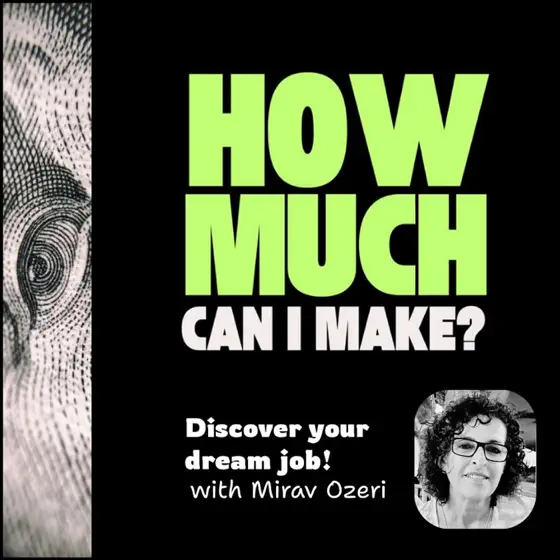
What this podcast really covers
The premise of the show sounds simple — ask real professionals how much they make — but the execution reveals something structurally more ambitious. Mirav Ozeri treats income not as a final answer but as the lens through which to examine an entire career ecosystem. When she interviews a mycologist, the conversation covers what it takes to build a commercial mushroom operation, what markets exist for specialty fungi, what the startup costs look like, and where income actually comes from at different scales. The earnings figure arrives with full context, not in isolation.
This approach makes the show function as applied career research rather than career inspiration. A listener considering a shift into ecommerce product photography learns not just that the field exists but what equipment investment is required, how to build a client base from scratch, what platforms matter, and what a realistic annual income looks like in the first three years versus after a decade. The same pattern applies to every episode: architecture, life coaching, voice-over work, immersive visual production. The show maps the full financial and professional landscape of each career it examines.
The breadth of professions covered is deliberate. By placing a city planner and a personal trainer in adjacent episodes, the show implicitly argues that the methodology for evaluating a career — not the career itself — is what transfers across disciplines. Listeners absorb a framework for asking better questions, regardless of which profession they are actually considering.
Who this podcast is essential for
Professionals considering a career change gain the most direct value. The show provides precisely what job postings and company websites withhold: the honest income trajectory, the hidden costs of entry, the daily friction that experienced practitioners have learned to manage. An episode on life coaching, for instance, tells a listener exactly what certification pathway leads to clients, what client acquisition actually looks like in practice, and what monthly revenue is realistic in the first year — information that typically requires either expensive career coaching or years of trial and error to obtain.
Students and early-career professionals use the show as a pre-professional orientation tool. Before committing to an architecture degree, for example, a prospective student can listen to a working architect describe the full span of the career: the licensure timeline, the salary at each stage, the studio culture, and the economic realities of running an independent practice versus working at a large firm. This kind of granular, first-person orientation has historically been available only to those with the right professional networks.
Entrepreneurs and side-hustle builders find the episodes on non-traditional careers — mediums, mycologists, immersive visual artists, voice-over professionals — particularly useful. These professions operate almost entirely outside corporate hiring pipelines, which means the business model, pricing strategy, and client development approach are the primary variables. The show exposes exactly how practitioners in these fields have built income from unconventional skill sets, making it directly applicable to anyone building a revenue stream outside traditional employment.
What the episodes really reveal
Across the episode catalog, several patterns emerge with enough consistency to constitute genuine findings rather than anecdotes. First: the gap between a profession's public image and its actual income structure is almost always significant. Personal trainers are widely assumed to earn low hourly wages; the show reveals that independent trainers running their own programming can generate six-figure revenues with the right positioning. City planners are assumed to be well-compensated public servants; episodes expose how compensation diverges sharply between government roles and private consulting, and how geographic location compounds that divergence.
Second: the cost of entry — in time, money, and credentials — is almost always underestimated by outsiders and overestimated in the wrong places by insiders. An architecture career requires years of post-degree internship before licensure; a voice-over career requires relatively modest equipment investment but substantial time investment in coaching and audition volume. The show consistently disaggregates these two dimensions — financial cost and time cost — rather than collapsing them into a single "difficulty" assessment.
Third: nearly every profession covered has a ceiling-breaking minority who have restructured their relationship with the work to access income far above the median. The Feldenkrais practitioner working with infants, the mycologist who has built a specialty wholesale operation, the immersive visual artist who combines travel, technology, and creative direction — these are not outliers who got lucky. They are practitioners who identified the highest-value application of their skill set and built toward it deliberately. The show returns to this pattern repeatedly, making it one of its most durable practical lessons.
What this changes in practice
The most direct practical outcome of engaging with this show is the ability to ask better questions before committing to a professional direction. Most career research stops at job title, required degree, and median salary. The show trains listeners to go further: What does income look like at the 25th percentile, not just the median? What is the difference in earning power between salaried and self-employed practitioners in the same field? What is the realistic timeline from entry to stable income? What are the structural barriers — licensing, geography, capital requirements — that constrain the income ceiling for most practitioners?
These questions, applied consistently, produce better career decisions. They also produce more honest conversations between professionals at different career stages — the kind of transparency that the show itself models in every episode. For anyone advising others on career decisions, whether formally as a counselor or informally as a mentor, the show provides a vocabulary and a framework for having those conversations with real specificity rather than generic encouragement.
The cumulative effect of the episode catalog is a working map of how income actually distributes across the professional landscape — not as economists model it, but as practitioners live it. That map, built from primary sources across wildly different industries, is the show's most durable contribution.